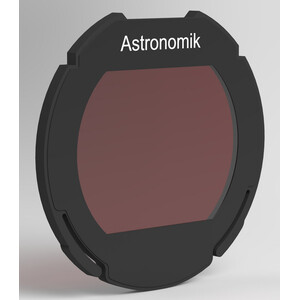
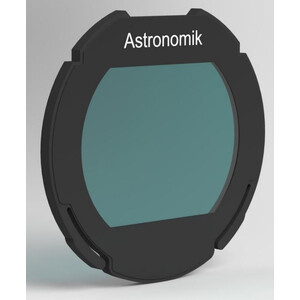
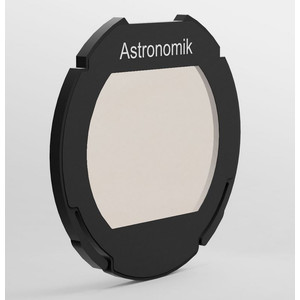
Astronomik XT filters for wide-angle lenses: The new Astronomik XT filters have been specially developed for astrophotography with wide-angle lenses and deliver sharp star images right into the corners of the image.
Astronomik clip-on filters have been a popular and well-known accessory for astrophotographers around the world for many years. However, when using lenses with very short focal lengths for wide-angle photography, standard clip-on filters can cause aberrations, and the stars in the outermost corners of the image become streaked. To solve this problem, the new Astronomik XT filters are mounted on an extremely thin substrate with a thickness of only 0.3 mm or 0.5 mm, which significantly reduces these aberrations.
Despite their reduced thickness, Astronomik XT filters offer the highest optical quality: they are finely polished, free of streaks, internal stresses and bubbles, and suitable for the most demanding applications.
Astronomik XT filters are manufactured using the same durable coating technology as all Astronomik filters. They are extremely scratch-resistant, insensitive to high humidity and non-ageing. This ensures that they maintain their performance for years to come.
Please note that not all Astronomik filters are available as XT versions, as the manufacture of these extremely thin filters is very complex. Currently, filters are being produced that are ideal for photography with wide-angle lenses.
This filter is suitable for photography from areas with artificial light pollution using cameras that are also sensitive to infrared. It enhances the contrast of all deep sky objects. If your camera already has an IR filter, you can also use the slightly cheaper CLS filters (without the "CCD" suffix) from Astronomik.
The CLS CCD filter increases the contrast between astronomical objects and the sky background. Due to the wide transmission range, a large amount of light can pass through the filter, so stars are only slightly attenuated. This filter is optimised to block as much stray light as possible and allow as much light from the objects to pass through as possible. The filter is ideal for use on telescopes of all apertures with aperture ratios from 1:2 to 1:15.
Mode of action
The filter completely blocks the emission lines of low- and high-pressure lamps (mercury (Hg) and sodium (Na)) and the lines of the airglow. All important emission lines of astronomical objects and the spectral range in which the eye has maximum sensitivity at night are transmitted. The integrated IR blocking layer allows use with digital cameras and webcams without their own IR filter.
Tips and further usage information
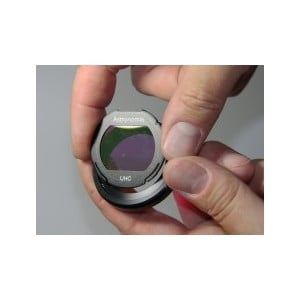
As an EOS clip filter, photography with DSLR cameras is possible even with extreme light pollution without damaging the colour balance. As a 1.25" and 2" version, it is also suitable for visual observation from light-polluted areas.
Alternatives
If an IR filter is already available for electronic photography, the more affordable CLS filter is a good option.
Suitability of the filter
- Visual observation (country): Good, with light pollution from mercury vapour lamps
- Visual observation (city): Neutral, a UHC-E or UHC filter is more suitable
- Conventional film: Very good, white balance is very good
- CCD astrophotography: Very good, optimal suppression of light pollution
- DSLR astrophotography (unmodified): Very good, colour shift but improved contrast
- DSLR astrophotography (astromodified): Very good, white balance is very good
- DSLR astrophotography (modified with MC clear glass): Very good, white balance is very good
- Webcam / video (Planets): Not suitable
- Webcam / video (deep sky): Very good if light pollution is a major problem
Technical data for the filter
- 95% transmission at 486 nm (H-beta)
- 95% transmission at 496 nm (OIII)
- 95% transmission at 501 nm (OIII)
- 97% transmission at 656 nm (H alpha)
- 1. Passband 450 nm to 520 nm
- 2. Passing range 640 nm to 690 nm
- Homofocal with all other Astronomik filters
- Not sensitive to moisture, non-ageing, scratch-resistant
- Fine-optical polished carrier material
- The filter is supplied in durable packaging
Please note: In principle, all camera lenses can be used with the Clip-Filter - i.e. Canon EF lenses or camera lenses from other third party manufacturers such as Sigma, Tamron, Tokina, Walimex etc. However, the use of clip-filters with Canon EF-S lenses is NOT possible!
A bit of help with your selection:
- As a first filter, we recommend the Astronomik CLS filter. This filter suppresses artificial light pollution and natural airglow. By using this filter you get a dark-sky background and can therefore use much longer exposure times to make fainter objects visible. The filter is optimised in such a way that objects are reproduced in their natural colours. Important: the simple CLS filter has no built-in IR-blocking. Therefore you will need the CLS-CCD filter for an astro-modified camera!
- A good choice for working in locations with really heavy light pollution is the Astronomik UHC filter. The transmission curve of this filter only allows the light of the H-beta, OIII, H-alpha and SII lines to pass through. The background suppression is significantly stronger than with the CLS, however this filter works only for gas nebulae! Star clusters and galaxies are largely filtered out.
- For a more in-depth introduction to astrophotography, we recommend the OIII, H-alpha and SII emission lines filters, available with full width at half maximum of 6nm or 12nm. With these filters you can create detailed images of faint objects even from locations with extreme light pollution and a full Moon high above in the sky. Images in these narrow emission lines are not naturally coloured.
- For the owners of astro-modified cameras we offer the Astronomik OWB filter: OWB stands for "original white balance". The filter corrects the displaced colour reproduction of a converted camera so that it can also be used for normal every-day photography, without having to revise every image on the computer.