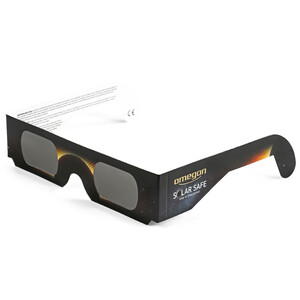
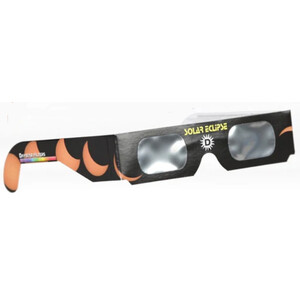
A cosmic spectacle – maximum protection
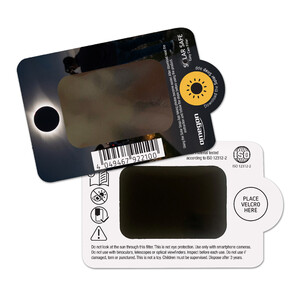
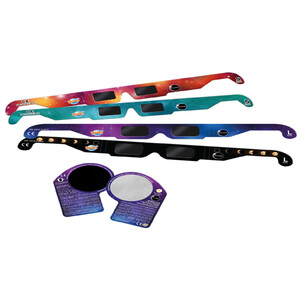
A rare event: the Moon passes in front of the Sun. Would you like to experience this too? Omegon solar eclipse glasses make it possible. Safely and without compromise. These special solar eclipse glasses provide ideal protection for your eyes during observations of the Sun without magnification.
The advantages at a glance:
- Scratch-resistant polymer lenses with an optical density of 5 – filtering out 100% of harmful ultraviolet and infrared rays and 99.999% of intense visible light, allowing you to safely observe all phases of the solar eclipse.
- The specially coated film ensures a crystal-clear image and a natural, orange tint to the sun.
- Manufactured in the USA, ISO 12312-2 compliant and CE certified – for the highest level of protection.
Solar eclipses in 2027 and 2028 – special events for solar observers
Following the total solar eclipse of 2026, the next event will take place as early as 6 February 2027. On that day, an annular solar eclipse will occur. The annularity zone will stretch across the south of South America and the Atlantic Ocean as far as West Africa. Amongst other places, the characteristic solar ring will be visible in parts of Argentina, Uruguay, Brazil and several countries in West Africa. Just half a year later, on 2 August 2027, the next major astronomical event will follow in the form of a total solar eclipse. On that day, the Moon’s umbra will pass over the Strait of Gibraltar and Andalusia, continuing on across North Africa. The central path will pass through Spain, Morocco, Algeria, Tunisia, Libya and Egypt, amongst others, thus spanning three entire continents. The eclipse will take place in the late morning, so the Sun will be high in the sky and will be easily visible without the need for a specific observation location. In Luxor, the total eclipse will last for more than six minutes! In large parts of Europe, the solar eclipse will be partial.
There will also be two solar eclipses in 2028. The first, an annular solar eclipse, will take place on 26 January. Its central path will pass over South America, the Atlantic Ocean and Spain, amongst other places . As the Moon does not completely cover the Sun during an annular eclipse, a bright ring of sunlight remains visible during the peak of the eclipse. This will be followed on 22 July 2028 by a total solar eclipse. The path of totality will pass over Australia and New Zealand. Sydney, too, lies within the path of totality. However, observation of this event will not be possible in Europe.
The Sun – always worth a look!
Even when there is no solar eclipse, you can safely observe the Sun using the Omegon Solar Safe solar eclipse glasses. With a bit of luck, you might even spot larger sunspots or birds or aeroplanes flying past the Sun. In general, you can also catch a glimpse of the rare transits of planets such as Mercury.
This product allows you to perform safe observation of the sun. Here’s how:
- Partial solar eclipse: The moon has not yet completely covered the sun. During this time, you must keep the Filter or protective cover fitted!
- Total solar eclipse:* Once the last of the sunlight has disappeared from the edge of the Moon (“diamond ring”), the filter may be removed. The total phase is brief: just a few minutes. Enjoy it, but remain vigilant: when the “diamond ring” reappears behind the Moon, put the filter back on the telescope or binoculars!
- The same applies to solar observation glasses (special protective glasses for solar observation): during the partial phase, only look at the Sun through these glasses; during the total phase, remove the solar observation glasses.
* Many solar eclipses are only partial. In that case, the protection naturally remains on your telescope or your nose the whole time.