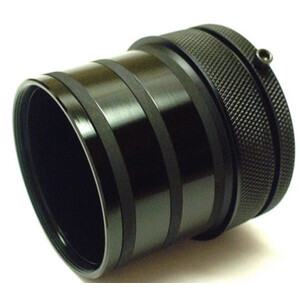
Hotech Field Flattner - How to get flat and sharp astrophotographs right to the edge of the image...
Refractors have a tendency to produce optical errors at the edge of the image. This results in an image field that is not uniformly flat but curved. These image field curvatures are unattractive and make the stars appear blurred, out of focus or distorted. However, aesthetics should be a priority when astrophotography with a refractor. Fortunately, there is a little helper...
Same focal length – flat field
Astrophotography that is sharp right to the edge. Wouldn't that be nice? With the Hotech FieldFlattner, you can achieve this – and it's really easy!
Attach this small, stylishly designed component to your refractor, whether it is an apochromatic or achromatic refractor. Your telescope should have an aperture ratio between f/5 and f/8, as this is what the optics are designed for. Many flatteners flatten the image but change the focal length. Your big advantage: the focal length of your telescope remains the same.
Precisely centred
What good is a field flattener that creates errors just because it has been tilted in the focuser? The devil is often in the details. The Hotech Field Flattener therefore has a self-centring mechanism. Insert the 2" adaptor into the focuser and turn the integrated ring until the mount clamps itself into the focuser using compression rings. There is no tilting due to screws pressing on the sides, and tolerances in the 2" focusers are no longer an issue. This brand new mechanical concept has been patented – and it brings better quality to your photos.
The advantages at a glance:
- Suitable for refractors from f/5 to f/8
- Absolutely flat image, right into the corners of the field
- Anti-reflection: multi-coating on the optical surfaces
- No tilting: 2" sleeve with self-centring mechanism
- 2" plug-in sleeve/T-2 thread on camera side
- Requires 55 mm distance from rear stop to chip plane
Our expert comment:
There should be a distance of 55 mm between the thread of the flattener and the camera sensor. This value should be adhered to as closely as possible. The flange focal distances of cameras can be found under the heading ‘flange focal distance’ on Wikipedia.
For example, if you intend to use an EOS with a flange focal distance of 44 mm and the T2 ring is 9 mm thick, a further 2 mm of clearance is required. Suitable 2 mm spacer rings and washers are available from photography retailers. Sleeves for greater clearances can be found at:
and here:
(Bernd Gährken)