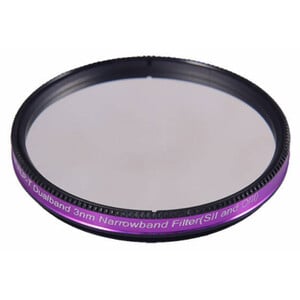
SII filter: The narrowband S-II 7nm filter passes light at 672nm wavelength with a bandpass of 3nm which is designed for nebula fotography.
It is suitable for most emission nebulae, planetary nebulae and supernova remnants.
f you want the look of Hubble Space Telescope (HST) images, such as the famous “Pillars of Creation” (the Eagle Nebula, Messier 16), then the next filter to consider adding to your collection after H-a and OIII is the SII (es-two) or sulfur filter. The SII filter, like H-a, is a deep red filter near 672 nm. H-a, OIII and SII filters provide that Hubble look for many emission nebula. Again, tri-color narrowband imaging with these three filters can be done with the moon up, so your equipment is not sitting dormant for several weeks.
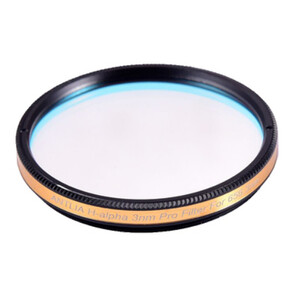
Antlia nebulae filters offer extreme contrast. This enables astrophotographers to achieve excellent results even in the presence of significant stray light from cities or the Moon. Antlia guarantees a transmission of at least 88 per cent within a 1 nm bandwidth around the central passband. This makes the narrow-band filters particularly suitable for fast telescopes and objectives. Even at an extreme aperture ratio of f/3, there is only a minimal loss of transmission.