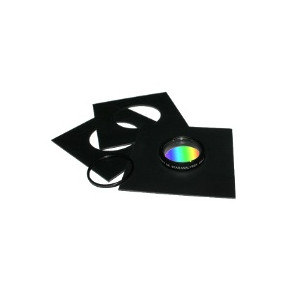
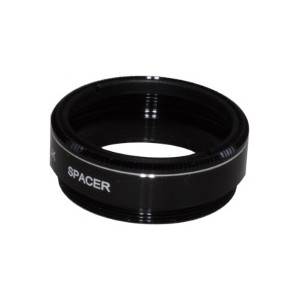
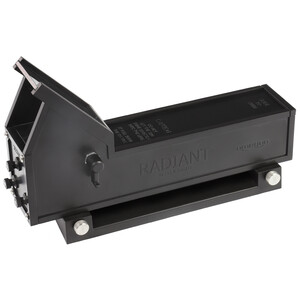
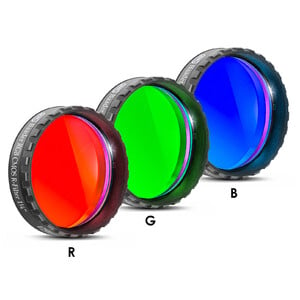
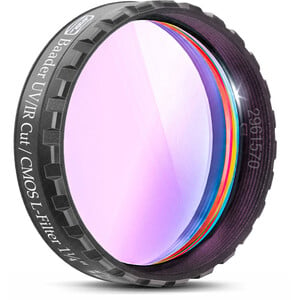
The Star Analyser is a diffraction grating that easily produces a stellar spectrum from the light passing through it. Therefore, the Star Analyser simply needs to be inserted like a filter into the 1.25” thread of the eyepiece or camera. This is done using the standard filter thread – it couldn’t be simpler!
Since its launch in 2005, the Star Analyser has introduced 100,000 amateur astronomers to the fascinating field of spectroscopy. During this period, the instruments used by amateur astronomers have evolved: telescopes with larger apertures, larger camera sensors and filter wheels with a short optical length. Consequently, a new model of the Star Analyser, the Star Analyser 200, has been developed. It features the same Blaze diffraction grating technology as the Star Analyser 100, but with double the line density. The Star Analyser 200 is designed for users who find it difficult to achieve the optimal path length required for the Star Analyser 100. The Star Analyser 200 produces the same spectral length but requires only half the distance compared to the Star Analyser 100.
Features of the Star Analyser 200-F:
- Low profile: 7.7 mm including thread, making it suitable for use in narrow filter wheels. By way of comparison, the Star Analyser 100 measures 11.2 mm. However, due to this low profile, unlike the Star Analyser 100, there is no additional filter thread in the housing for further accessories.
- Highly efficient Blaze grating with 200 lines per millimetre
- For ease of use, the direction of the spectrum is marked on the filter ring
- Optimised for large apertures, long focal lengths and large sensors
- The star and spectrum are captured in a single image, which is helpful during calibration
For most users, the Star Analyser 100 remains the model of choice, particularly for those using cameras with small sensors who screw the Star Analyser directly into the filter thread of the camera’s eyepiece socket.